How to Choose a Reliable Kitchenware Manufacturer in India
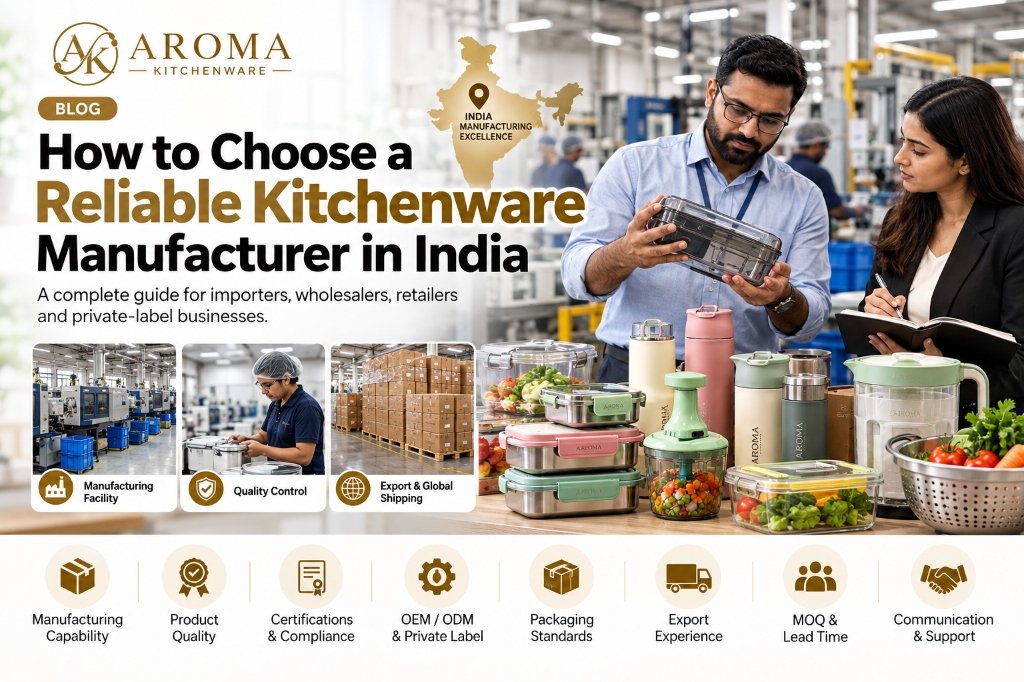
A practical checklist for importers, wholesalers, retailers, distributors, and private-label brands evaluating kitchenware manufacturers in India. Key insights on quality control, OEM/ODM capabilities, MOQs, export documentation, and shipping packaging.
Reading Time: 6–7 minutes
Target Audience: Importers, wholesalers, retailers, distributors, e-commerce brands & private-label businesses
Choosing the right kitchenware manufacturer in India is an important decision for any business. The right manufacturing partner can help you maintain consistent product quality, control costs, develop private-label products, and manage large orders efficiently.
However, comparing manufacturers only by price can create problems later. Product quality, manufacturing capability, certifications, customization, packaging, export experience, and delivery reliability should all be considered before placing a bulk order.
Here is a practical checklist to help you evaluate an Indian kitchenware manufacturer.
1. Check Whether They Are a Manufacturer or Trader
One of the first things to verify is whether the company actually manufactures products or primarily sources them from other suppliers.
A direct manufacturer may provide better visibility into:
- Raw materials
- Production processes
- Quality control
- Product customization
- Packaging
- Production capacity
- Lead times
Ask the supplier about their manufacturing facility, production capabilities, machinery, product categories, and factory operations. For larger orders, you can also request factory photographs, videos, product samples, or arrange a factory visit where practical.
2. Evaluate Product Quality and Materials
Kitchenware comes into regular contact with food, water, heat, and cleaning products, so material selection is important.
Before ordering, ask for detailed specifications such as:
- Material type and grade (e.g. SS 304 vs SS 201, Food-grade Polypropylene / ABS)
- Product dimensions & thickness
- Capacity & weight
- Surface finish (Mirror polish, matte powder-coat)
- Food-contact safety compliance
- Durability & testing reports
Don't rely only on descriptions such as "premium quality." Put important specifications in writing so that the quotation, sample, and production order can be compared against the same requirements.
3. Ask About Quality Control
A reliable manufacturer should have a defined quality-control process rather than checking products only when an order is finished.
Ask key questions such as:
- How are incoming raw materials checked?
- Is production inspected during active manufacturing?
- How are defective products isolated and handled?
- Is there a pre-shipment final inspection?
- Can inspection reports or photographs be provided?
- Can third-party inspection (SGS, Bureau Veritas) be arranged?
For export orders, quality checks should also consider the regulatory requirements of the destination market.
4. Check Certifications and Compliance
Certifications and compliance requirements depend on the product and destination market. Before placing an order, ask the manufacturer which certifications and test reports apply to your products and target market.
For example, international buyers may need documentation relating to:
- Food-contact safety (FDA, EFSA)
- Material composition certificates
- Quality-management systems (ISO 9001:2015)
- Destination-country safety regulations
- Packaging and barcode labeling
Do not assume that a certification for one product automatically applies to every product manufactured by the supplier. Verify the relevant documentation for the specific product and market.
5. Look at OEM, ODM and Private-Label Capabilities
If you are building your own kitchenware brand, customization capabilities are critical.
Depending on the manufacturer, customization may include:
- Brand logo (Laser etching, screen printing, embossing)
- Customized product colors & finishes
- Private label inner gift boxes & artwork
- Barcode labeling & SKU tags
- Custom product combinations & sets
- Export master carton branding
OEM generally involves manufacturing according to buyer-controlled specifications, while ODM involves manufacturer input into product design and tooling. For example, Aroma Kitchen Ware provides end-to-end OEM/ODM private labeling, custom laser logo engraving, customized color boxes, and heavy-duty 5-ply export master cartons.
6. Request Samples Before Bulk Production
Never evaluate a manufacturer only from product photographs. Request physical samples and evaluate:
- Appearance: Surface finish, color consistency, logo placement, edge smoothness
- Functionality: How the product operates, lid locking, fit & assembly, ease of cleaning
- Packaging Integrity: Product protection, box sturdiness, label accuracy, barcode scanning
If the sample is approved, document the exact specifications clearly and keep an approved physical sample as a reference baseline for bulk production.
7. Compare MOQ, Pricing and Lead Time
Price alone should not determine your supplier selection. When comparing manufacturer quotations, evaluate the complete cost matrix:
| Factor | What to Check |
|---|---|
| Unit Price | Price per piece (FOB / CIF / EXW) |
| MOQ | Minimum order quantity per SKU or container load |
| Sample Cost | Sample fee & development charges |
| Tooling | Mold or custom tooling charges |
| Packaging | Inner box & master-carton packaging specs |
| Lead Time | Production & dispatch timeline |
| Payment Terms | Advance deposit & balance against B/L |
| Shipping Terms | Agreed Incoterms (FOB Mundra / JNPT) |
| Repeat Orders | Price stability and long-term consistency |
A slightly different unit price can become significant when multiplied across a large order, so compare quotations using the exact same product specification and packaging requirements.
8. Check Production Capacity
If your business grows, your manufacturer needs to be able to support increasing order volumes without delays.
Ask the supplier:
- What is the monthly production capacity?
- What is the standard production lead time?
- How are rush orders handled during peak season?
- How many automated production lines are operational?
- What is the raw material & finished goods warehouse capacity?
This becomes particularly important for global distributors, supermarket chains, e-commerce brands, and high-volume importers.
9. Evaluate Export Logistics Experience
For international buyers, manufacturing capability is only one part of the process. The supplier should understand export logistics thoroughly:
- Export documentation (Invoice, Packing List, Certificate of Origin, B/L)
- Export-grade master carton packaging & corner strapping
- Container loading & volumetric nesting
- Customs seal & fumigation compliance
- Destination-market customs clearance needs
A manufacturer with established export processes makes coordination seamless for international buyers. Aroma Kitchen Ware exports to 65+ countries worldwide and provides complete export trade compliance, warehousing, and ocean freight logistics services.
10. Check Packaging for International Shipping
Kitchenware can experience scratches, dents, or moisture damage during transit, especially on long ocean freight voyages.
Verify that the manufacturer uses:
- Individual anti-scratch poly film or bubble wrap
- Moisture-absorbent silica gel desiccants
- Sturdy E-flute inner color boxes
- 5-Ply heavy kraft export master cartons
- Container volumetric nesting & cargo strapping
For example, Aroma Kitchen Ware packs all export consignments in 5-ply virgin kraft master cartons with plastic corner protectors and desiccant packs to resist humidity during sea freight transit.
11. Look for a Wide Product Range
If you are a distributor or retailer, working with a manufacturer offering multiple related categories can streamline your supply chain.
For example, Aroma Kitchen Ware offers a broad B2B catalog including lunch boxes, insulated hot pots, food storage containers, vegetable choppers, water jugs, tumblers, sink organizers, and strainers. Consolidating multiple product lines with one reliable manufacturer reduces administrative overhead and freight costs.
12. Check Communication and After-Sales Support
Clear communication is essential during custom manufacturing and export shipments.
Before placing a bulk order, identify:
- Your dedicated export sales manager
- Written documentation procedure for specification changes
- Sample sign-off process
- Production milestone updates
- Quality issue resolution protocol
- Reorder procedures and shipping tracking
A manufacturer that clearly documents specifications, approvals, timelines, and responsibilities ensures smooth, hassle-free bulk production.
---
Partner with Aroma Kitchen Ware for Reliable Sourcing
As a premier manufacturer and exporter of stainless steel and plastic kitchenware in Rajkot, Gujarat, Aroma Kitchen Ware supplies international importers, distributors, and private-label brands across 65+ countries with certified quality, OEM custom branding, and direct factory pricing.
Have Questions or Need Bulk Quotation?
Direct factory sourcing support from Aroma Kitchen Ware, Rajkot India.